 844.883.2483
How Property Managers Can Create Consistent Listing Photos Across a Rental Portfolio
The ease of managing a single rental property cannot be overstated: hire a photographer, get some great photos, and list the property. When managing ten, twenty or even fifty rental properties however, things get a little more complicated. As long as you are using different photos for different properties then you may have some inconsistent listing photos but overall it won't cause too much harm. However, once you start to see that many inconsistent listing photos appear under one landlord then the perception of disorganization is likely to set in quickly with prospective renters.
Consistency is not a 'nice to have' for portfolio managers, it is a competitive advantage.
Here is how to build a repeatable photography process that scales with your portfolio.
Why Consistency Matters More at Scale
All the inconsistent images for a single property are a problem. But dozens of inconsistent images for dozens of properties signal complete disorganization. Renters can now browse dozens of listings in a single session of time. Your images must look as if they all belong on one landlord's website, not on ten different websites.
According to the National Association of Realtors' research on real estate listings, homes that are photographed professionally get more views, sell faster, and attract better quality renters than those with poorly taken photos of the property.
Visual consistency also helps manage your rental property operation more efficiently. Standardized photographs enable you to more easily train staff and manage listings. You are also able to audit your listings for consistency more easily, to identify properties that require redecoration.
Start With a Written Photography Standard
Before hiring a photographer or taking photos yourself, write up a one-page document on how you want the listing to look. This photography standard can be used by you and future vendors.
Your written standard should specify camera type and minimum resolution requirements, along with a wide-angle lens (16mm to 24mm equivalent) for all photography so that rooms show their full size. It should also cover the use of natural light supplemented with on-camera or off-camera flash, orientation rules (horizontal for all listing photos), editing style including color temperature and exposure targets, prohibited items (personal belongings, trash bins, unmade beds, and the like), and turnaround time for edited image delivery.
This document can be referenced in all vendor agreements and is used as an internal checklist. Vendors that cannot meet the standards of this document would not be hired.
Build a Standard Shot List for Every Unit Type
A shot list removes subjectivity. A photographer can't choose which rooms to take photos of a property when you have created a reliable baseline shot list for a standard apartment or single-family rental.
A reliable baseline shot list for a standard apartment or single-family rental includes:
- Exterior front of the unit
- Exterior rear of the unit (if applicable)
- Parking/Garage (where applicable)
- Entryway or foyer
- Living room from two angles
- Kitchen from two angles, including appliances and countertops
- Each bedroom from the doorway and one interior angle.
- Each full bathroom and each half bath
- Laundry room or closet
- Any unique features the apartment has to offer such as a balcony, backyard, etc. with upgraded fixtures.
- Building amenities (gym, lobby, pool etc.) for multi-family homes.
Be sure to make adjustments to your shot list based on the number of bedrooms and bathrooms in a home. For example, a studio unit will require less documentation than a three-bedroom home. Save the shot list to a shared folder to access during the scheduling process for each property type in your portfolio.
Establish Clear Staging Guidelines
Regardless of the skill level of your chosen photographer, photos of your rental properties capture what is in the room. To achieve quality images, your units must be staged consistently before each shoot.
Staging rental properties for their photography does not necessarily mean that you will have to rent furniture for the purpose or hire a professional staging company to come in and stage the unit. A pre-shoot checklist that becomes part of the turnover process for the property is the best way to ensure that a well-staged unit is delivered to the photographer for the rental property's photography.
The pre-shoot checklist should cover:
- All personal items and clutter removed
- Counters and surfaces cleared except for intentional decor
- Toilet lids closed, towels folded and hung
- All lights on. All bulbs of similar color temperature (to avoid color cast)
- Window blinds or curtains opened to maximize natural light.
- HVAC vents dusted and visible fixtures cleaned
- Landscaping trimmed for exterior shots
When staging is considered a part of the maintenance of the property it becomes a very predictable quality photo. By building the visual preparation of the property for rental marketing into their leasing workflow, property management companies like CMC Realty & Property Management can become more scalable to grow their rental business and fill their vacant homes fast.
Schedule Photography Around Turnovers
Many property managers scramble to take photos of vacant properties after they have been vacant for days, wasting money that could be spent marketing the property. Incorporating photography into the tenant move out process can save a property manager a lot of money and reduce stress in trying to fill a vacant rental property quickly.
Building the photography into the calendar for turnover of units is ideal and can become part of the normal process for turnover of rental units. Here is a typical sequence of events that would include photography:
- Outgoing tenant vacates
- Cleaning and maintenance completed
- Staging checklist completed by maintenance staff
- Photography scheduled within 48 hours of turnover completion
- Edited images delivered and listing published within 24 hours of shoot.
Keeping organized, up-to-date visual records of each property is simply good practice for a landlord or property management company, and it makes documenting a unit's condition over time far easier if a dispute ever comes up.
Know When to Refresh Existing Photos
Even the best portfolios grow old and stale over time. A three- or four-year-old photo of a unit's interior may show outdated appliances, worn carpeting, or worn-out and soiled furniture and decor that no longer accurately reflects the unit in question.
It's time to refresh listing photos when a unit receives significant renovations or upgrades, when appliances, flooring, or countertops are replaced, when exterior landscaping or curb appeal changes substantially, when the existing photos are more than two to three years old, or when a unit sits vacant longer than expected despite active marketing.
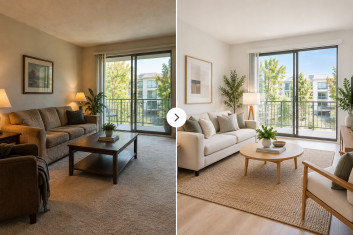
For units that sit vacant and need a quick visual boost without a full reshoot, virtual staging for vacant homes can be a cost-effective way to present an empty unit in its best light.
Renters today have more listings to compare than ever, and they're making snap judgments based on photos before they ever schedule a tour. Stale, outdated photos simply don't hold up in that environment.
Organize and Archive Images at the Portfolio Level
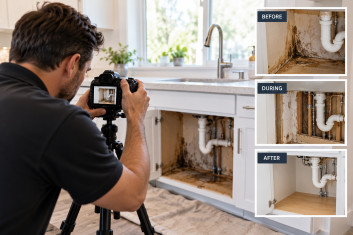
Consistency means having a systematic approach to organizing images at the portfolio level. Developing a file naming convention and folder structure (i.e., organizing how you save your original and edited images) helps ensure that the landlord has access to the appropriate images for the listing as well as for comparison purposes before and after completing work to a unit.
A reliable system looks like:
- `/Portfolio/[Property Address]/[YYYY-MM]/Originals`
- `/Portfolio/[Property Address]/[YYYY-MM]/Edited`
This enables you to rapidly retrieve images of listed units, to compare 'before and after' photos of a unit that has undergone renovation, and to distribute images to various platforms, agents and other third parties.
The Process Is the Product
For a single property owner, great photos are a one-off project. But for a portfolio manager, great, consistent photos of all your properties are an ongoing system to run. And, to scale, you need to run this system as you would any other part of your operation: with documented standards, clear timelines, and held accountable vendors.
By building a system to do high quality photography once, you'll get to complete lease-ups faster every time thereafter.